
Your mid-month pulse on the signals shaping community & regional banking.
March brought three developments that don’t obviously connect — but together they raise a question every community institution should be asking: are we structured to compete in a system that’s being rebuilt around us? The rules governing small business lending just changed. A crypto firm now sits on the same payment system as your bank. And regulatory relief, while real, is moving faster than most institutions are positioned to act on it.
P.S. Treasury yields moved meaningfully higher this week as markets reacted to conflict in the Middle East and renewed inflation concerns — with the 10-year climbing toward 4.3% and 30-year mortgage rates posting their largest weekly increase since April 2025. Community institutions with rate-sensitive portfolios or mortgage pipelines should be watching this carefully.
Signal #1 | The SBA rewrites the rules for small business lending
What’s happening The SBA discontinued its Small Business Scoring Service (SBSS) for 7(a) loans under $350,000 and replaced it with a direct cash flow requirement: borrowers must demonstrate a debt service coverage ratio of at least 1.1:1 on a historical and/or projected basis. Separately, the SBA now requires that 100% of all direct and indirect owners of an applicant business be U.S. citizens or nationals with their principal residence in the United States, its territories, or possessions. Permanent residents — green card holders — are no longer eligible for SBA financing.
Why it matters
The shift from SBSS to DSCR changes the underwriting workflow for smaller 7(a) loans. Lenders who built processes around the scoring model will need to retool, and documentation requirements on borrowers increase meaningfully.
The citizenship requirement is the more consequential change for many community markets. In areas with significant immigrant entrepreneurship, permanent residents who have been reliable small business borrowers are now ineligible — disrupting existing relationships, not just future pipeline.
Compliance implications are immediate: eligibility screening needs to be updated, and loan officers need clarity on how to communicate these changes to affected applicants.
There may be downstream CRA effects if previously qualifying borrowers are redirected to conventional or alternative products at higher cost or less favorable terms.
Questions for your leadership / board
How are our SBA loan originators being trained on the new DSCR requirement, and what does the documentation change mean for our small business pipeline?
Have we mapped our existing SBA portfolio and prospective borrower base against the new citizenship eligibility rule — and do we know how many current relationships could be affected?
For borrowers who no longer qualify under SBA guidelines, what conventional or alternative products can we offer — and are we prepared to have that conversation proactively?
How might these changes affect our CRA strategy or our positioning as a small business lender in markets with diverse ownership demographics?
Signal #2 | The payments system just got a new participant
What’s happening The Federal Reserve Bank of Kansas City granted a master account to Kraken Financial — the banking arm of crypto exchange Kraken, chartered as a special-purpose depository institution in Wyoming — making it the first crypto firm to gain direct access to the Fed’s core payment system. At the same time, Mastercard and Visa are both moving to integrate stablecoin firms into their networks, tokenized deposit platforms are launching with community bank participants, and the FDIC has clarified that payment stablecoins won’t qualify for pass-through deposit insurance (meaning stablecoin holders can’t claim FDIC coverage through a bank partner).
Why it matters
Direct Fed access for a crypto-chartered institution opens the payment system to a new class of competitor. The payment system is no longer exclusively reserved for traditional banks.
Stablecoin infrastructure is advancing faster than policy. With major card networks integrating crypto settlement, the payment ecosystem is being rebuilt in real time — often around community banks, not with them.
The FDIC’s deposit insurance clarification matters: it signals that regulators intend to keep a hard boundary between insured deposits and digital-token alternatives, at least for now.
Control follows access. Institutions that aren’t part of how emerging payment infrastructure is authenticated and routed risk becoming invisible utilities while others control the customer experience and economics.
Questions for your leadership / board
How are our payment and settlement relationships evolving — and are the partners we rely on today positioning themselves inside these new networks?
What’s our read on tokenized deposits or stablecoin-adjacent products? Not whether to offer them today, but whether we understand what’s coming.
Are we engaging our regulators and core providers around digital payment infrastructure — or waiting for guidance to arrive?
Signal #3 | Regulatory relief is real — and a bigger rewrite may be coming
What’s happening The OCC finalized two rules reducing burden for community banks: simplified licensing requirements for corporate activities at institutions under $30 billion in assets, and the removal of an outdated Fair Housing data collection requirement. The White House issued an executive order directing regulators to tailor mortgage rules for community banks — covering Regulation Z adjustments, expanded FHLB access, and modernized appraisal requirements.
Looking ahead, Fed Vice Chair for Supervision Michelle Bowman previewed a broader capital framework overhaul due before month’s end — touching stress testing, the supplementary leverage ratio, Basel III, and the G-SIB surcharge. The Basel III revisions would extend to most banks, moderately reducing capital requirements for mortgage, consumer, and business lending.
Why it matters
The OCC licensing simplification is practical and immediate — confirm with counsel whether the “covered community bank” definition applies and what activities are now expedited.
The White House mortgage order and the Bowman capital preview point in the same direction: regulators appear to be actively working to reverse the drift of mortgage and lending activity toward nonbanks.
These are still proposals — comment periods follow, and final rules may look different. The planning window is now.
Relief in one area rarely means a lighter touch everywhere. Governance, third-party risk, and AI oversight expectations continue to evolve.
Questions for your leadership / board
Have we assessed which OCC licensing simplifications apply to activities we’re currently pursuing or planning?
As capital and mortgage rules are potentially simplified, where should we reinvest freed capacity — and is that conversation happening now, not after finalization?
Are we engaging in the comment process, directly or through trade associations, to put community bank perspectives on the record?
How are we presenting these developments to our board in a way that’s strategic, not just technical?
Closing Insight
Here’s something I’ve been telling community bank and credit union audiences in recent presentations about agentic AI: open ChatGPT or any AI assistant and ask it to list all of your checking accounts, their key fees, and eligibility rules — using only your public website. If it can’t do it cleanly, neither can the agent shopping on your customer’s behalf.
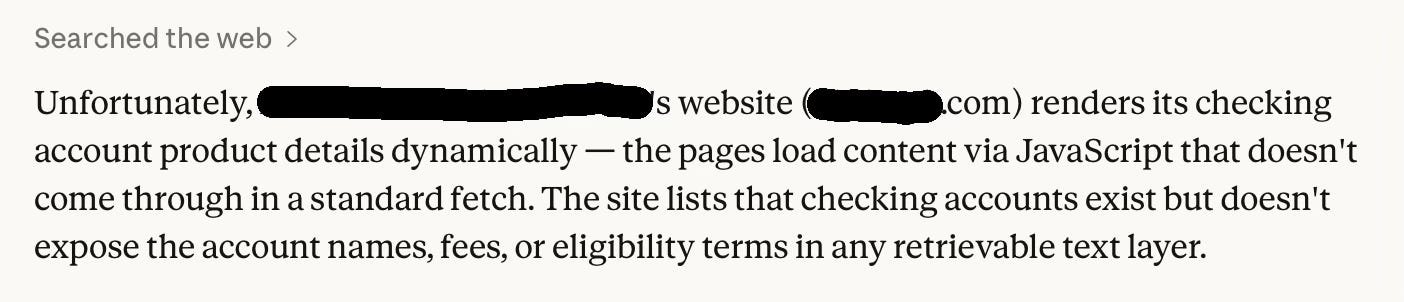
Your digital presence is no longer just marketing content. It’s infrastructure.
