
Your mid-month pulse on the signals shaping community & regional banking.
February’s headlines may look disconnected at first glance — stablecoins, large-bank mergers, and charter activity — but together they point to something bigger: the boundaries around who can attract deposits, control customer relationships, and even operate like a bank are widening. For community institutions, this month is less about reacting to news and more about recognizing how funding, scale, and structure are starting to shift simultaneously.
Signal #1 | The stablecoin debate shifts toward deposits
What’s happening Major U.S. banks have intensified lobbying against proposals that would allow dollar-pegged stablecoins to pay interest through nonbank intermediaries. Banks argue that yield-bearing tokens could pull significant amounts of cash out of traditional deposits, shrinking funding bases — particularly for smaller institutions that rely heavily on relationship deposits.
Supporters counter that interest-bearing stablecoins would improve returns for consumers and force more competition around pricing and innovation.
Why it matters
Deposit competition may expand beyond banks, changing how customers think about cash-like savings.
Smaller institutions could feel pressure first if rate comparisons increasingly include token-based alternatives.
Even if adoption remains early, the debate itself signals that the definition of “deposits” may be evolving.
Questions for your leadership / board
How sensitive is our funding model to deposit migration driven by yield competition?
Are we educating ourselves — through regular board-level briefings and direct customer or member feedback — to understand how stablecoin adoption might affect demand for deposits?
If stablecoins gain traction, what role — if any — should we play as partner, provider, or observer?
Signal #2 | Scale keeps reshaping the map — and the number of smaller banks
What’s happening Fifth Third has completed its merger with Comerica, creating the ninth-largest U.S. bank at roughly $294 billion in assets and expanding its footprint across the Midwest, Texas, California, and the Southeast. Meanwhile, Banco Santander announced plans to acquire Webster Financial, significantly expanding its U.S. presence and deposit base.
These moves aren’t isolated. They reflect a broader trend: consolidation continues to reshape the banking landscape, with scale increasingly driven by strategic geography, commercial relationships, and long-term growth corridors rather than pure asset accumulation.
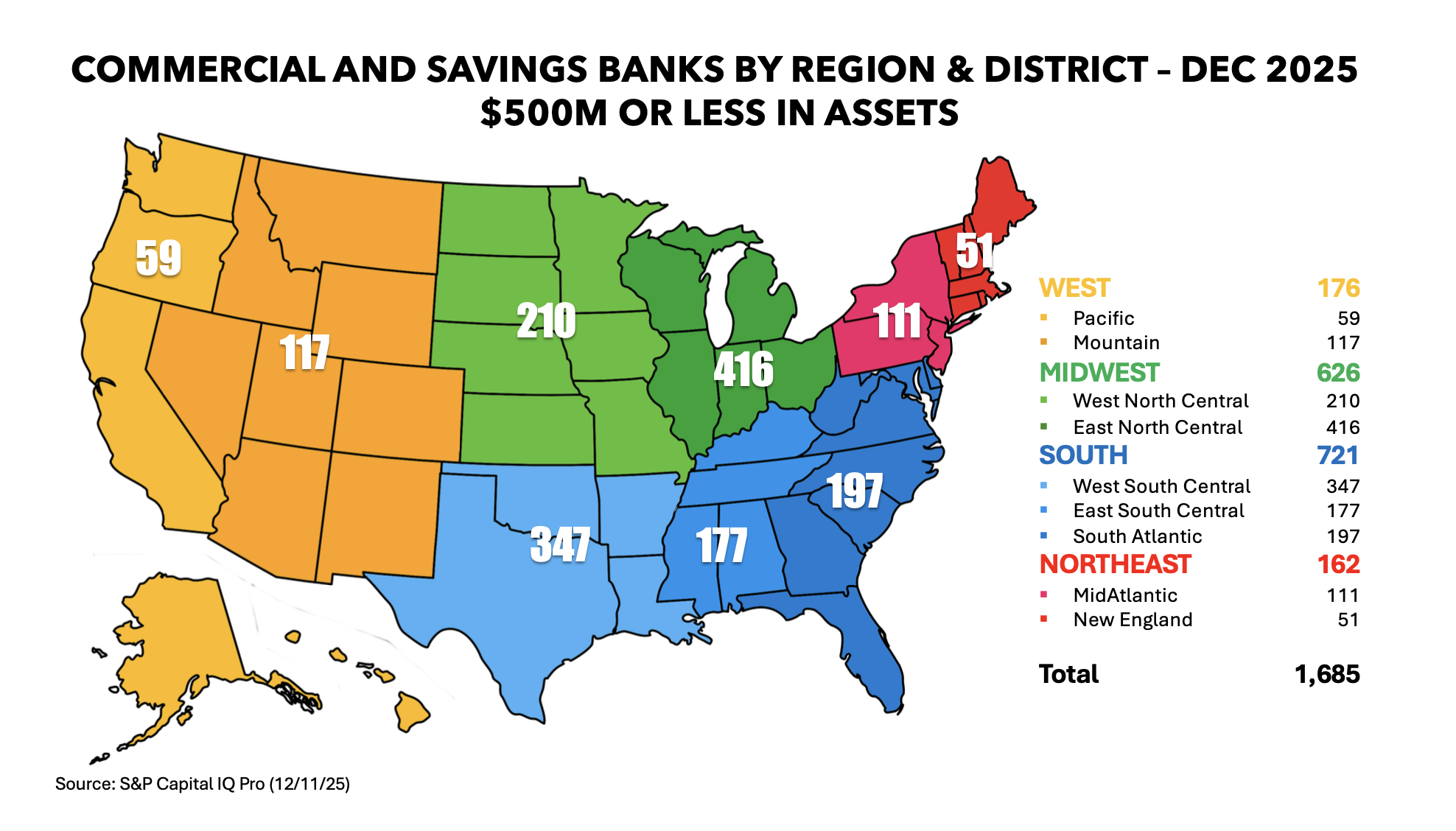
One way to visualize that shift is through the steady decline in smaller institutions. The map below shows how many commercial and savings banks with $500M or less in assets remain across the country — a reminder that consolidation is not just a headline cycle, but a structural change that has been quietly redrawing where and how community banking operates.
Why it matters
Scale is becoming less about growth for its own sake and more about competitive economics — funding technology investment, supporting specialized talent, and operating efficiently across the right markets.
At the same time, the shrinking number of smaller institutions changes local dynamics. Consolidation often creates gaps in service, attention, and relationship continuity — which can either challenge community banks or create openings, depending on how well institutions understand their position.
For smaller banks and credit unions, the takeaway isn’t automatically “get bigger.” It’s to be clear about where scale truly matters — and where focus, specialization, and community presence remain durable advantages.
Questions for your leadership / board
How is consolidation changing the competitive map in our specific markets?
Where might scale-driven mergers create opportunities for us to deepen relationships or attract talent?
Are we clear about where size benefits us — and where strategic focus gives us an edge?
Signal #3 | Regulatory posture is shifting — and the charter conversation is back
What’s happening Regulators continue to recalibrate oversight heading into 2026. The Federal Reserve finalized stress-test scenarios while maintaining existing stress capital buffers through 2027 as revised models are developed. At the same time, policymakers are signaling potential adjustments to capital requirements and tailoring standards for institutions below $250 billion in assets, alongside updates to AML expectations and exam priorities.
Another under-the-radar development: regulators have approved new industrial loan company (ILC) initiatives tied to large commercial firms, including automakers like Ford and General Motors. More broadly, charter applications are rising, with fintechs and other nonbank firms seeking licenses that allow them to embed lending, payments, and deposit gathering directly into their platforms.
Taken together, these signals suggest the charter landscape is widening — not only for banks, but for companies that historically operated outside the banking system.
Why it matters
Regulatory changes may increase optionality — but also expand the competitive perimeter.
The re-emergence of ILC activity signals that banking services can increasingly sit inside commercial ecosystems.
New charters and platform-based entrants could reshape where deposits and relationships originate.
Supervisory expectations may evolve toward demonstrating effectiveness rather than simply compliance.
Questions for your leadership / board
Have we revisited how new charter activity — including ILCs — could affect our competitive landscape?
How might platform-based entrants influence where deposits and lending relationships are formed?
Are we engaging regulators early enough to understand how expectations around structure, governance, and risk are evolving?
Closing Insight
February’s story is about boundaries — and how they’re beginning to move. Deposits are being challenged by new digital alternatives, scale continues to reshape regional competition, and regulators appear more open to allowing new entrants and structures into the banking system.
For community banks and credit unions, the move isn’t to chase every change. It’s to stay clear-eyed about where funding, competition, and regulation intersect — and to make deliberate choices about where to compete, where to partner, and where discipline is your advantage.
